


No chants, no signs, just footsteps echoing down the halls. On January 20 at 2 p.m., students at Woodgrove silently walked out of their classrooms in order to be a part of a movement responding to Immigration and Customs Enforcement (ICE) policies and their effects on communities. Groups of students filed through the front of the school, some nervous, some determined, all united by a shared purpose.
The demonstration was part of the “Free America Walkout” a coordinated protest across the country calling attention to immigration policies and enforcement actions by ICE. Students throughout the United States took part in the protest in different ways. Senior Isabelle Delleart led the organization of the walkout, making Woodgrove one of the first participants out of thirteen other high schools in the Loudoun County Public Schools (LCPS) district. Dellart “didn’t expect [the walkout] to get as big as it did,” with around 80 students at Woodgrove leaving their classrooms to show their support for this movement. “I organized this walkout because I wanted to let communities know, especially here in this county, that they’re not alone,” Delleart explained.
While walkouts are permitted, they must be in accordance with LCPS Policy 8273, which states that the usage of signs, flags, pictures, banners and other visual props are not authorized during walkouts. Additionally, students who participate in any demonstrations, must do so in a “peaceful and orderly” manner. “During my meetings and discussions with Dr. Shipp, he went over the policies with me, and I made sure all of the students that agreed to participate also knew about the policies,” Delleart commented. “I was really nervous about it because I’m like, ‘Well that’s not gonna be a walkout,’ because the policies that allow the walkout to happen makes it not a real walkout.” After discussing frustrations with her peers and parents, Delleart decided that the policy wasn’t going to stop her from holding the walkout. “Yes it’s good to make sure that you prepare correctly, but the point of a protest is to disrupt,” Delleart expressed.
For many participants, the choice to participate in the walkout was driven by personal connections to the cause. Junior Aspen Ortiz, was one of the students who supported the walkout. She shared that her decision to walk out was deeply connected to her identity. “I’m Hispanic and it’s part of my culture. This is something that means a lot to me, means a lot to my friends and my family, and this is just something to me worth walking out for,” Ortiz commented. Other students chose to walk out not only for themselves, but also as a way to stand in place for people in places who do not have the freedom to protest. Ryker Cawthorne, a junior who experienced the walkout, wanted to show his support for promoting safety amongst all. “My family is not from America. I’m glad that we can all come together and support one thing for people that may not be able to in other places,” Cawthorne expressed.
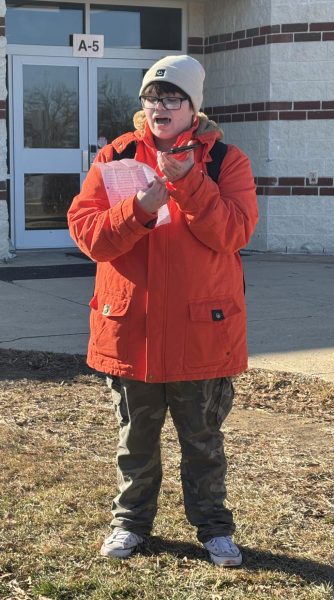
During the walkout, students socialized, danced, and played music. Senior Desmond Hernandez, delivered a speech that shared his personal connections towards the movement and his encouragement to keep speaking out. “I’m not someone that speaks a lot in school, so giving a speech was really anxiety inducing,” Hernandez commented. “Even though we’re young, we can still have our voices heard and we can still take action.”
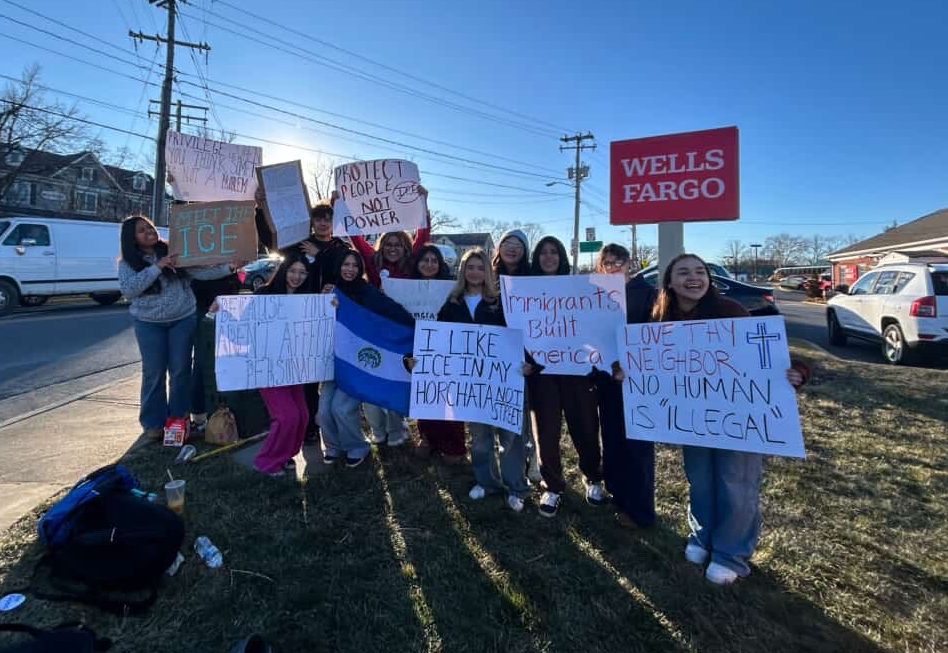
After about 25 minutes of protesting on the school’s campus, a group of students made their way to the town of Purcellville, while other students returned to their classrooms. The students who decided to further protest either walked or drove to the rendezvous point in Purcellville. Sophomore Jackie Jimenez, was one of the students who protested in Purcellville. “We went to get supplies as we weren’t allowed to have signs at the school. We all made our own [signs] in the McDonald’s, and then we went out to protest on the corner,” Jimenez stated.
The walkout was more than just students leaving class. For many, it was a chance to stand in solidarity with immigrant communities and speak out about issues that impact their lives beyond the classroom. As discussions around the actions of I.C.E continue, the walkout serves as a reminder that student voices matter and can bring attention to important issues. Cawthorne stated, “Keep showing support. Keep talking about it. We can’t just let it die down because that’s how things are going to get worse.”