


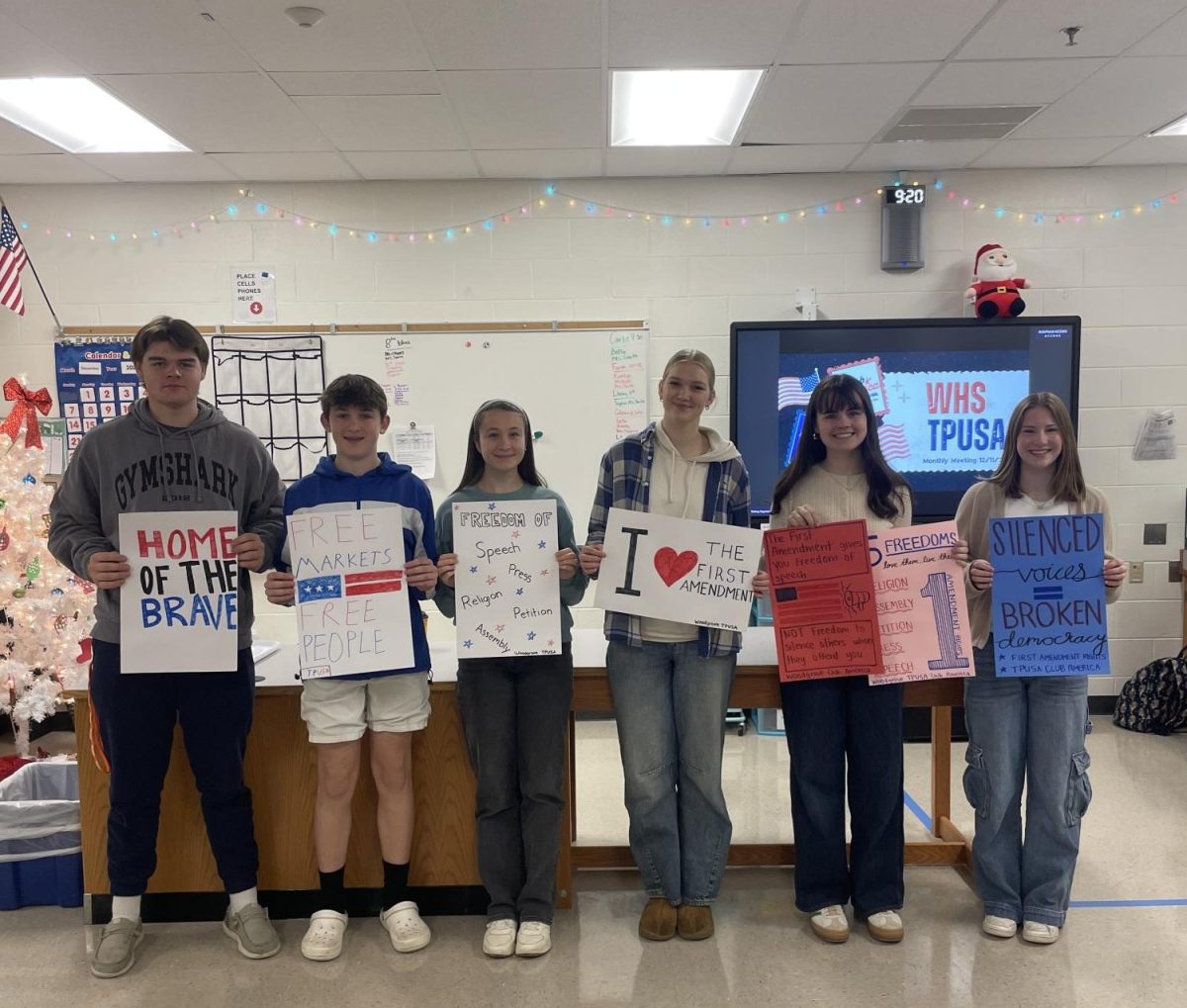
Rights stated on a paper dating back two centuries ago mean little if students cannot exercise them. At Woodgrove, student life extends beyond classrooms and academics into conversations, clubs, and causes that matter to students. These moments are not just expressions of opinion; they are examples of the freedoms students are learning to use. While political and social clubs are sometimes questioned or misunderstood, they represent the First Amendment in action, giving students a chance to exercise free speech, assembly, and expression within the structure of a school environment.
The First Amendment of the Bill of Rights guarantees five fundamental freedoms: religion, speech, press, assembly, and petition. Although these rights are often discussed in legal or political contexts, they are also deeply relevant in schools where students are learning how to engage with ideas, beliefs, and one another. At Woodgrove, student clubs provide a space where these freedoms can be practiced responsibly rather than abstractly.
Several student organizations at the school provide opportunities for political and social engagement. Clubs such as the Debate Team, Turning Point USA (TPUSA), Gay-Straight Alliance (GSA), Minority Student Union (MSU), and several faith-based clubs allow students to explore ideas, discuss current events, and advocate for issues that matter to them.
Student clubs are protected by the Equal Access Act (EAA), a federal law ensuring students at public schools can form voluntary organizations regardless of their beliefs. Schools cannot discriminate against clubs based on focus, as long as meetings are student-led. This allows students to explore interests, practice leadership, and engage in dialogue within a structured environment. Anna Verhey, a junior and the President of TPUSA, used the guidelines of the EAA to kickstart the club. “There was a little bit of pushback when I was first trying to start TPUSA because of the political nature of it,” Verhey explained. “There’s this little paragraph in the club proposal that I wrote that explained why this club was compliant and I cited the EAA.”
Freedom of speech and expression is one of the most visible ways students exercise their First Amendment rights through clubs. The Debate Team provides a structured environment where members can share opinions, challenge ideas, and communicate persuasively. Similarly, GSA and MSU offer spaces for students to express their personal experiences and advocate for issues affecting their communities. Senior Izzie Jensen, co-president of MSU, has been a part of the club for all four years. “Not all but many members, including myself, identify with minority identities and we all enjoy being in a space that celebrates that instead of fearing it.” Jensen expressed. “This club is important to us to also raise awareness and talk about our experiences with cultural injustices in and outside of school.”
Freedom of religion and assembly are also key parts of how students can express their First Amendment rights through clubs. Woodgrove offers various religious clubs such as Fellowship club, Woodgrove Christians in Action, Fellowship of Christian Athletes, and Bible Study Club. Katie Bickart, a sophomore and one of the board members of Fellowship club shared that she became involved with Fellowship club because she liked how the club brought in pastors and youth ministers to preach about the Bible and gospel to the members “This club is important to me because it continues to teach me how to grow with God. It’s also important for my community, because some people don’t go to church so this is where they can learn about God,” Bickart discussed.
Although Woodgrove does not have any clubs that appeal to minority religions, such as faiths practiced by Jews or Muslims, the opportunity to start clubs for these groups is not out of reach. “I feel as if opportunities are present if someone feels as if they are not being represented,” Jensen commented. “If someone felt underrepresented, they’d be more than able to form a club.”
Supporting student clubs that reflect the freedoms of the First Amendment is essential for any school that wants to foster engaged and responsible students. These clubs provide a structured environment for dialogue, leadership and advocacy, helping students learn responsibility alongside their rights. These clubs navigate a diverse world, showing that exercising these freedoms are valuable skills for life, not just school. “The First Amendment is such a key part and cornerstone of our freedoms as Americans, especially as younger people,” Verhey declared. “We should be aware of those freedoms, we should exercise them, and we should be able to exercise them in our educational setting.”