


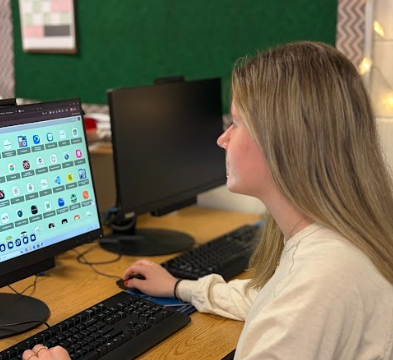
Students may use Artificial Intelligence (AI) to write essays, do homework, or study for tests. However, when students use AI to do work for them, it does not prepare them for future tests. Students should try to learn and make mistakes while they are still in school so that they can learn from them other than relying on an outside tool.
According to a University of Illinois article, “To best use AI in schools, teachers and administrators need to know AI’s advantages and challenges.” Teachers especially need to know more about AI, in order to know how to inform the students on how to use it correctly.
Mr. Kent Staneart, a psychology teacher at Woodgrove, believes that most teachers are against AI. He shared, “They don’t understand how it can be a resourceful tool and how they can use other ways to prevent it from just simply being a cheating tool.” While most teachers try to ban AI in their classrooms, they do not realize that in many cases, they are just encouraging the students to teach themselves how to use AI. This means students might not learn how to use it as anything more than a cheating tool.
Staneart helps teach his students how to use AI to be more than a cheating tool. “I make them handwrite everything, so they can’t just use [AI]. They actually have to learn from using it.” AI can be a useful tool when researching information, but making students write down the information helps them to learn and retain the information.
Woodgrove freshman Gabi Welch believes in using AI as needed to assist in learning. “AI can help clarify and help you know what’s going on or what the question is asking, especially for homework,” Welch shared. AI can be a very sourceful tool when she is doing homework because if she has a question, she will “ask it to basically summarize and explain it.”
Although AI can be a helpful tool, it does still have its concerns. Mrs. Elizabeth Wallace, an English teacher at Woodgrove, is against using AI in class. “If you’re using an outside source to do [schoolwork], then you’re not practicing those skills and not improving in the class,” Wallace shared. The University of Illinois believes, “If students learn to cheat and take shortcuts in classrooms, what kind of citizens will they make when they are finished with their education?”
An article written by EducationWeek about AI in schools stated, “70 percent of teachers worry that AI weakens critical thinking and research skills.” Wallace agreed, stating, “[Our brain] is like a muscle that we have to constantly be exercising. If we’re not exercising that or if we’re like relying on something else to do the job for us, then we’re not improving.”
AI is known for occasionally making errors. Staneart stated, “I’ll go back and make sure that I check every single question to make sure that every question was reliable. I check that it gave the correct answer and gave the reliable information.” Double checking AI helps to make sure that the students are receiving the correct information while also lightening the workload of teachers.
The University of Illinois also addressed the problem of AI making mistakes and explained, “If the data it draws from is inaccurate or biased, then the information it creates will be inaccurate or biased. Students need to learn how to evaluate and think critically about the information they come across and not just accept it at face value.” It is very important that students know how to check AI and the information it gives them. Even if they do try to use it as a cheating tool, it will not help if the information is not correct.
AI can be a resourceful tool when it comes to research and helping with schoolwork. However, students need to learn how to use AI as a helpful tool, not a cheating tool. Welch remarked, “If you ask AI to do all of your homework and you get to the test, it’s not going to help you. You’re not going to know how to do any of it, and you’ll just be stuck there staring at a blank piece of paper.”