


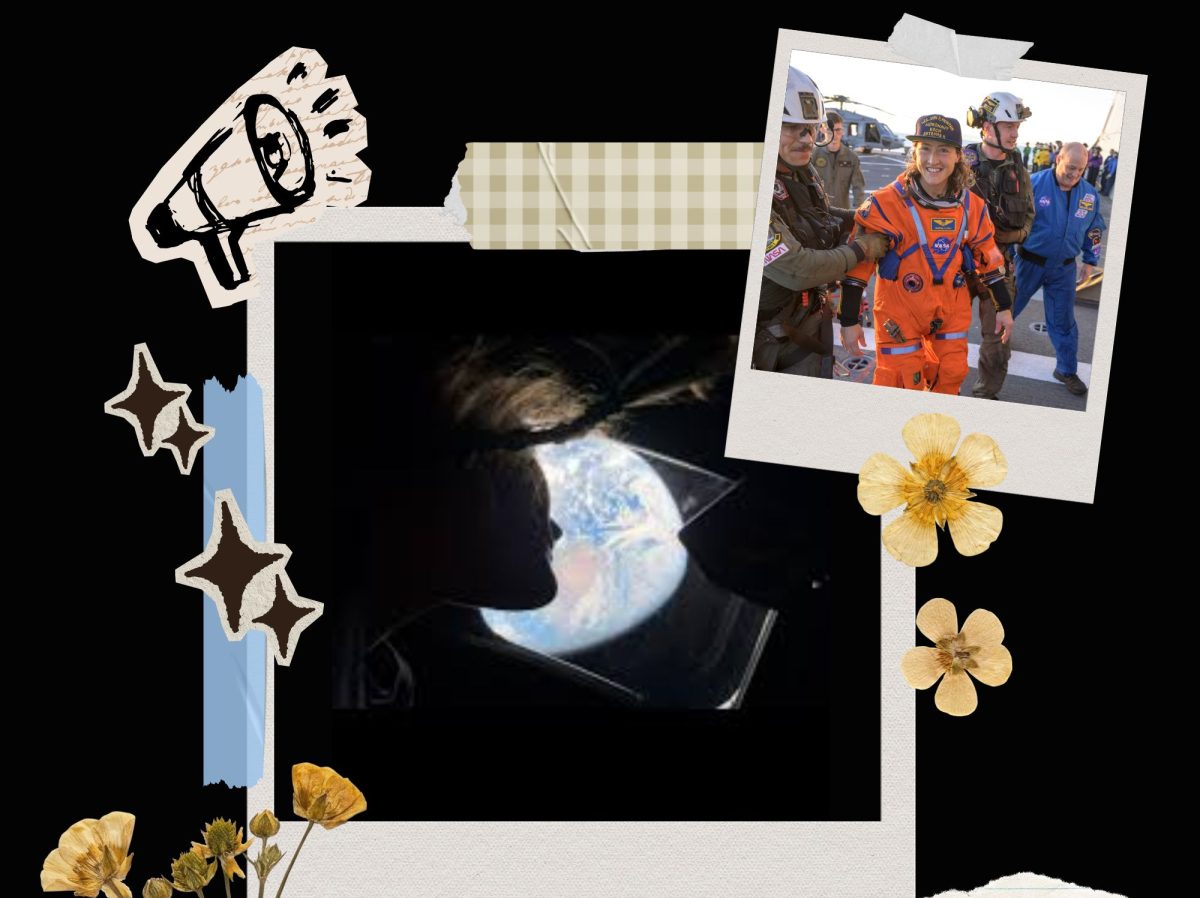
From April first through tenth, Artemis II carried four astronauts into the furthest part of space that mankind has ever reached. Many of Woodgrove’s students and staff followed the Artemis II mission, not only because of its distance accomplishment, but its crew. Specifically because of Christina Koch.
Koch brought change as a crew member compared to past missions like the original moon landing. In 1969, the first moon mission did not have any women on board, and even in more recent missions, women’s participation as a crew member has been scarce. In space and on earth, Christina Koch shares a passion in Science, Technology, Engineering, and Mathematics (STEM) and astronomy with many of Woodgrove’s students and staff.
Woodgrove offers many opportunities for students to get involved in their interests, from Astronomy Class and Club, to Aerospace Class, and Women in STEM club. STEM educator Ms. Georgina Bingaman connected the importance of these classes to Woodgrove’s motto, ‘Work, Honor and Strive,” explaining, “To work is to put in the effort to learn and grow in challenging subjects like science and math. To honor is to recognize those who’ve already paved the way when we do that. To strive is to push beyond our limits.”
Experiencing exclusion in her own life, Bingaman was the only woman in her engineering class, and one of two women at her job as an engineer. Bingaman shared, “There was only one female engineer there… I didn’t even know she was an engineer because they actually had her desk station outside of the engineering section. They didn’t even let her sit in there.” However, through shared identity, a small community was built between the two engineers. Bingaman explained, “I was like, ‘let’s create our own space…strengthen the masses even if only two.’”
Senior Jilian Conklin is a former Women in STEM club member who stepped away this year to start and lead Woodgrove’s astronomy club. Involved in classes such as Aerospace Engineering that emphasize her interests, Conklin has experienced a connection through her involvement in STEM. Her love for STEM formed from her interest in space missions. Conklin described, “I love the shuttle program because it inspired me to get into space and be interested in [science]. I hope that will be the same for girls and boys and whoever.”
Also inspired by the Artemis II mission, senior Astronomy student, Daisy Tramel, expressed, “I feel [like] women really haven’t been involved with a lot of space travel. It’s been mostly men. I think it’s great that women are being represented. We actually have someone out there to represent women as a whole, and I think that’s amazing.”
From the first moon mission to Artemis II, a lot of change has taken place. Bingaman claimed, “We’re integrating females the way we should. There’s a system that was in place that rarely were women given the opportunity in science and engineering. But NASA and other organizations are really trying to change that.” As more women like Koch become involved, the rising generation experiences normalising women’s engagement in STEM fields. Conklin explained, “[NASA] shows girls that they can do it too. I mean, if you just scroll through Instagram, you can see videos of young girls being inspired.”
As past generations observe Koch as an anticipated and exciting idea, a younger audience is becoming familiar with the concept of women holding the position of an astronaut. Much like Bingaman, Tramel shared, “I think that this could open up the door to inspire other women who could be the next strong astronomers and astronauts.” The hard work it takes to take on a space mission is slowly becoming more accessible to women. Conklin described “It shows that anybody can do it by working on it. We can get more women in space and in those higher positions.”
Bingaman watched the Artemis II launch with her two young granddaughters and their other grandparents. Observing the contrast between the two generations, Bingaman mentioned, “I’m watching those girls and it never even crossed their minds that this has never happened before. ‘Oh, there’s just a female astronaut. Okay, that makes sense because I’ve seen it in books and movies…’ so it made sense to them. Meanwhile, I watch the elders trying to hush them up because they were so excited.” While change is taking place, inclusion is a slow progression.
Bingaman reflected on the timeline of change, saying, “There is passion there, and we’re falling behind, it’s dumb. We shouldn’t fall behind anymore… I don’t think we’ve gotten very far. For as long as we’ve been a mess, for as many miles as we’ve gone, [we are] not very far at all.” Although there is work being done to change the amount of representation women have in STEM fields, there is still a lot of space to grow and better encourage the next generation to build their interests in STEM. “You guys are the Artemis generation…the generation of hope. Whether it’s working in logistics, [or as] the scientists, or the astronauts, commanders, or mission control people. Not everybody wants to be an astronaut, but NASA has over 90 different jobs for just one mission.”
While right now there still might not be equal representation, Koch’s example has accomplished a big advancement that has impacted many. To several, Koch did more than just go to space. Bingaman expressed, “When we see someone like Christina Koch on the mission to the moon, it sends us a powerful message that these careers are not out of reach.”
Tramel sees Koch’s impact is more than just important for women going into the STEM field. Tramel expressed, “I think it could really mean a step forward into being more equal between men and women and even other races. Equality as a whole, not just for women, but people. It doesn’t matter who they are or what they are, they should be able to excel. I think we’re moving in the right direction, showing people that women can be involved.”
Today, and for the future, Koch’s place is the Artemis II mission can be seen as an encouragement to the rising generation and a step into expanding interest in STEM to everyone.