


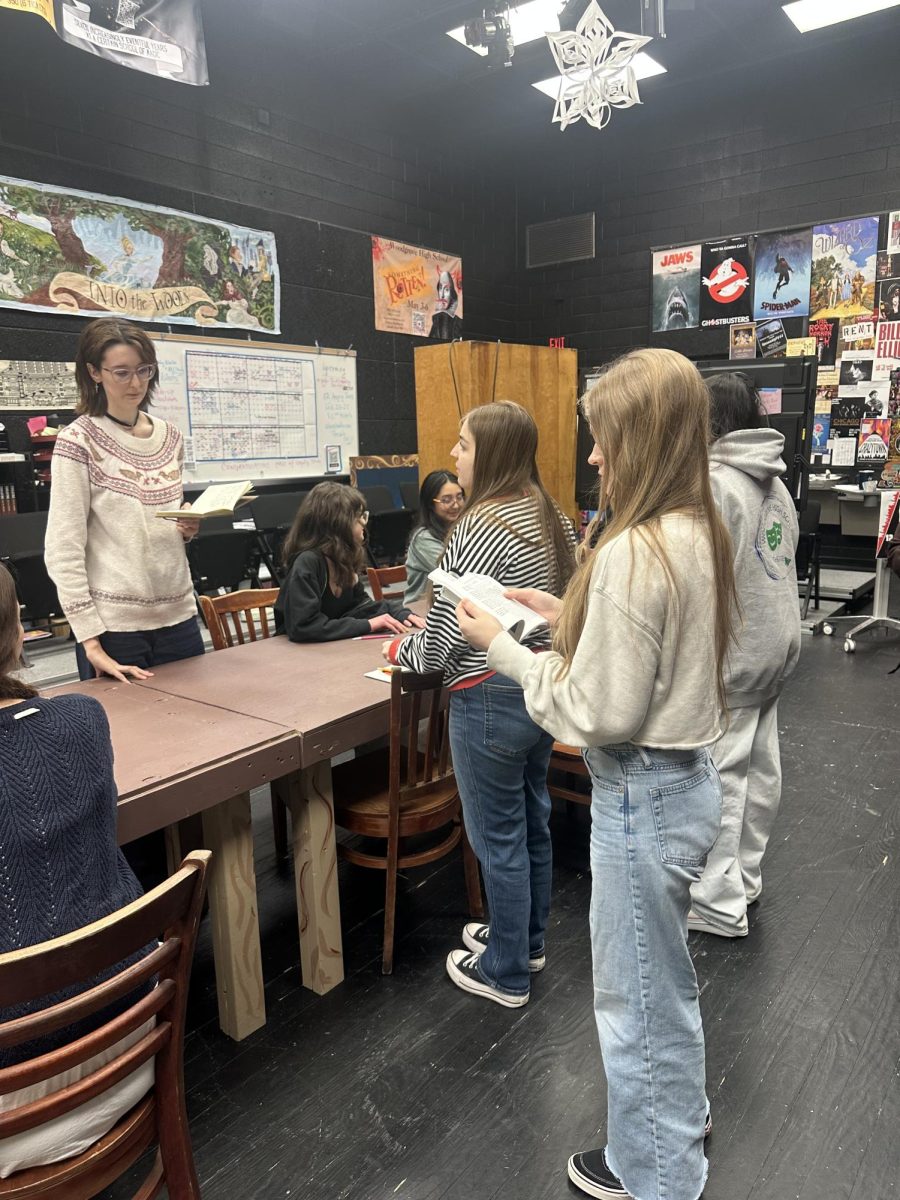
The 1957 film, “12 Angry Men,” is a legal drama in which 12 jurors deliberate over the murder of a beloved father, discussing whether the 18-year-old defendant is innocent or not. One juror is persistent in his belief of “reasonable doubt” regardless of the initial 11 to 1 guilty vote, sparking much conversation amongst the jury. Now, this same film comes to life in Woodgrove’s Black Box.
A production directed by senior London Thomas, 12 Angry Jurors is going to be performed at Woodgrove from February 25 – 28. Cast member and junior Ella Jaffee is eager to perform in this play. “12 Angry Jurors” is an adaptation of the really famous older movie, 12 Angry Men. It’s adapted to also be able to include women, and it’s about a murder trial that takes place in 1954, and they’re discussing whether or not they think the person on trial is guilty,” Jaffee stated. The performance starts off with only one juror thinking the suspect is innocent and ends with them all. Junior Charlotte Yao, who is playing Juror Number nine, said, “It’s kind of a slow turning of the tides as one pro-defendant juror becomes 11,”emphasizing how the tension slowly builds and the jurors turn their questions into facts.
However, 12 Angry Jurors is more of a private theatrical offering. This is because the show will take place in the black box: a room with limited seats where theater classes take place. In the black box, there is no stage. Instead the audience is encompassed along with the actors. “It’s our in-class production, so with theater classes three and four, it’s our required piece,” Yao stated. However, auditions still took place. “Our audition process lasted about a week. We read scenes from the script and acted them out, just to see whose voice sounded good next to whose, and how big each person can play the character,” cast member and senior Bella Towe shared. “It was a pretty chill audition process. We read for the roles and that was kind of it. We didn’t have to do a monologue or anything,” Jaffee added. The low-pressure auditions created a comfortable atmosphere where the actors could perform their best.
Although it is a private production, preparation is still necessary for success. Sophomore Jack Vosburgh, who plays Juror Number 11, took research into his own hands. “[My character] is from a broke country in Europe, so I’m researching different broke countries to try to pinpoint where he’s from,” Vosburgh shared. Other actors are going more traditional routes in their preparation. “One thing we talked about was representational versus presentational acting styles. We were studying Udahagen [a famous theater practitioner] and just looking at her methods and we chose what different approach we want to take with our characters,” Yao explained. Representational acting is a performance style where actors fully embody a character and act as if there is no audience, whereas presentational acting is based on acknowledging the audience. They do this by breaking the “fourth wall” and engaging the audience. This is a big part of this preparation for some actors. “I’m preparing for my part by learning the lines and also working on different acting techniques. I’m going with the presentational acting style,” Jaffee added, highlighting how this is not only a production, but part of a class that is furthering their acting skills.
Rehearsals are made easy for cast and crew of the 12 Angry Jurors, as it takes place during class time. First, Jaffee, the warm-up leader, leads the class in vocal exercises. After that, they dive right in. “Next, we decide which pages we’re going to do for blocking, which means where you are going to be on the stage, and what are you going to be doing during that time. Then, after that, we kind of decompress and have a water break or just end the class on a nice note,” Towe stated.
The play is a primarily student lead performance, with student directors, leaders, and stage managers. The stage manager for this production is senior Cooper Curtis. “My role is to make sure that everything in the rehearsal process goes smoothly, make the rehearsal calendar for the show, make sure our projects are getting done, and sets are being made,” Curtis explained. If you are interested in being stage manager, you need to work your way up. “You start on run-crew, which works under the stage manager. Once you’re on run-crew for a little bit, you work your way up to assistant stage manager. After assistant stage manager, you are stage manager. It takes years of practice and repetition so you have the skills to be a leader,” Curtis shared. This system works because it allows students to gain experience and prove they can handle the responsibility.
Memorizing lines is important, but can be a tricky part of every production. “Something that has really helped me with line memorization is Quizlet. [I’ll] put my que line in and then I use the flashcards,” Vosburgh stated. However, some actors use different techniques. “Something I do is I write them out. I write them so it kind of turns into muscle memory and it just sticks with me,” Jaffee reflected. These memorization strategies help the production run as smoothly as possible.
Beyond the stage, the production helps students grow in many other ways. “It’s a great way to grow your ability to just speak to someone, and a great way to grow your confidence in what you say and how you say it. You become a lot more true to yourself in that way,” Yao said. There is also a strong sense of community. “I think everybody gets along really well, and we all have really good energy. We’re all able to bounce off of each other really well, which makes this show pretty good, because it can get kind of boring if we don’t have a lot of energy,” Towe shared. “I would tell people to join [theater] because it’s a really good and inviting community. Everybody’s really nice to everybody and it’s just a great class.”